Anyone who travels to Sanremo for the first time quickly understands why the city has been attracting visitors from all over Europe for more than a hundred years. Nestled between the sea and the mountains, it welcomes its guests with a climate that is mild and sunny almost all year round. It is a place where lemon trees bear fruit in winter, bougainvillea blooms along the façades, and the air is filled with the scent of salt and flowers.
This special climate has not only made Sanremo a popular travel destination – it also gave rise to an entire region now known as the Riviera dei Fiori, the Flower Riviera. Here, flowers thrive in a diversity rarely found along Europe’s coasts. And it is precisely this natural abundance that laid the foundation for a story in which nature, trade, and tourism are closely intertwined.
1. The Climate of Sanremo – Mild, Sunny, and Stable
Sanremo’s climate is typically Mediterranean, but with a special advantage: it is more balanced than in many other places around the Mediterranean.
In summer, it is warm but rarely oppressively hot. Temperatures around 28°C are common, and a light sea breeze almost always keeps the air pleasant.
At night, the climate remains mild, perfect for evening walks along the promenade or a glass of wine on the terrace.
In winter, the thermometer rarely drops below 10°C. Snow or frost is a rarity here. Instead, citrus trees and oleanders bloom even in January and February. This mild climate has attracted people since the 19th century who wanted to escape the cold North—at that time especially wealthy English, Swiss, and Russian visitors who built their winter residences in Sanremo.
Rain falls throughout the year, but it usually comes in short, heavy showers. The summer months from June to September are largely dry, while autumn—especially October—brings slightly more rainfall.
2. A Sheltered Paradise – The Secret of the Microclimate
Sanremo’s mild climate is no coincidence. The city lies between the Ligurian Sea to the south and the foothills of the Alps to the north. This natural setting acts like a protective shield: the mountains block cold northern winds, while the sea helps maintain even temperatures. The result is what is known as a microclimate—pleasant not only for people, but also ideal for plants.
The sun shines on more than 300 days a year, and the light is soft, almost golden. It makes colors appear more vibrant—one reason why many painters and writers visited Sanremo in the 19th century. And it also explains why flowers grow so magnificently here: plenty of warmth, plenty of light, and hardly any frost.
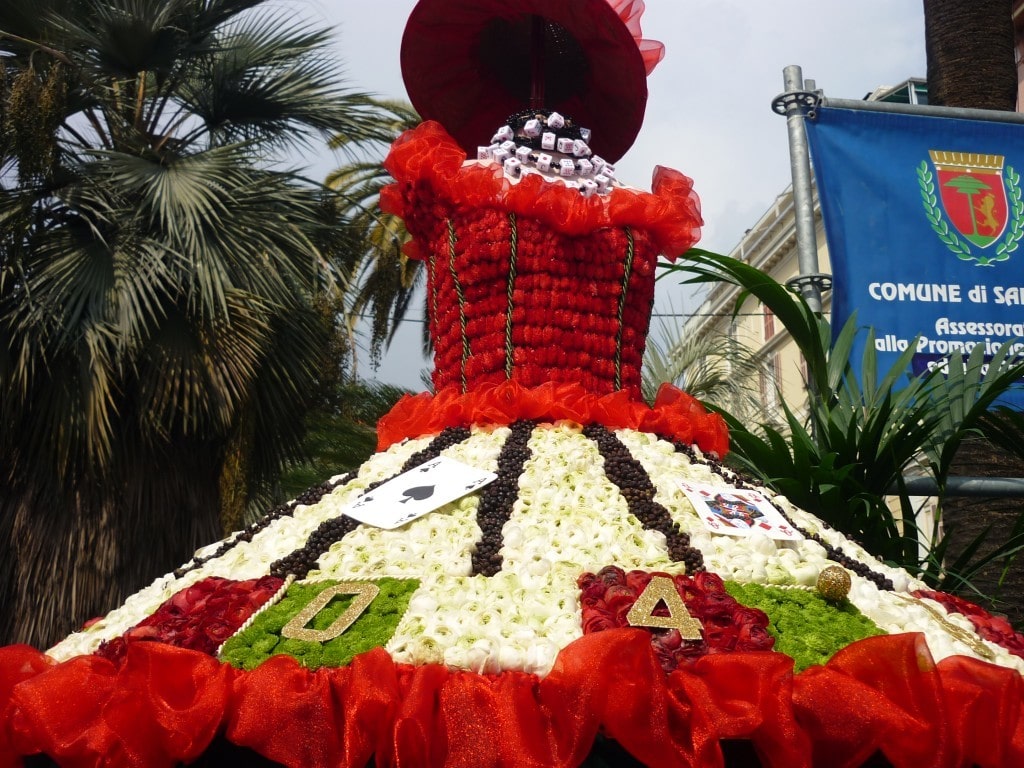
Fun Fact
The famous flower parade of Sanremo, held every spring, is called the “Corso Fiorito” — literally “flower-adorned procession.” Its roots date back to 1904, when beautifully decorated carriages first rolled through the city to celebrate the arrival of spring.
During the Second World War, the parade was suspended for several years, but after the war it returned as a symbol of renewal and joy of life. Today, it is one of the most colorful events along the entire Ligurian coast: more than 100,000 flowers are used each year for the floats, all sourced from the Sanremo region.
3. From Climate to Culture – The Birth of the Flower Riviera
These exceptional conditions led to large-scale flower cultivation around Sanremo from the late 19th century onward. Carnations, roses, mimosas, and anemones were grown, bundled, and exported in every direction. This is how the name Riviera dei Fiori—the Flower Riviera—came into being.
But the flowers were more than just an economic asset—they became part of the city’s identity. Sanremo adorned itself with gardens and parks, hotels were filled with the scent of fresh bouquets, and every spring the Corso Fiorito was celebrated, a magnificent flower parade that remains a cherished tradition to this day.
The interplay of climate, nature, and culture has made Sanremo a special place: a city that has remained both sophisticated and close to nature, elegant yet relaxed—much like the climate that made it all possible.